Lean Mass and Muscle Strength: Why Studies Measure Both
More fat-free mass is not automatically more strength or easier daily activity. A scan, a force test and a practical task measure different things. When a study reports a body-composition change, look for the separate strength and function results before accepting a claim about what people can do.
Name the body-composition quantity and method
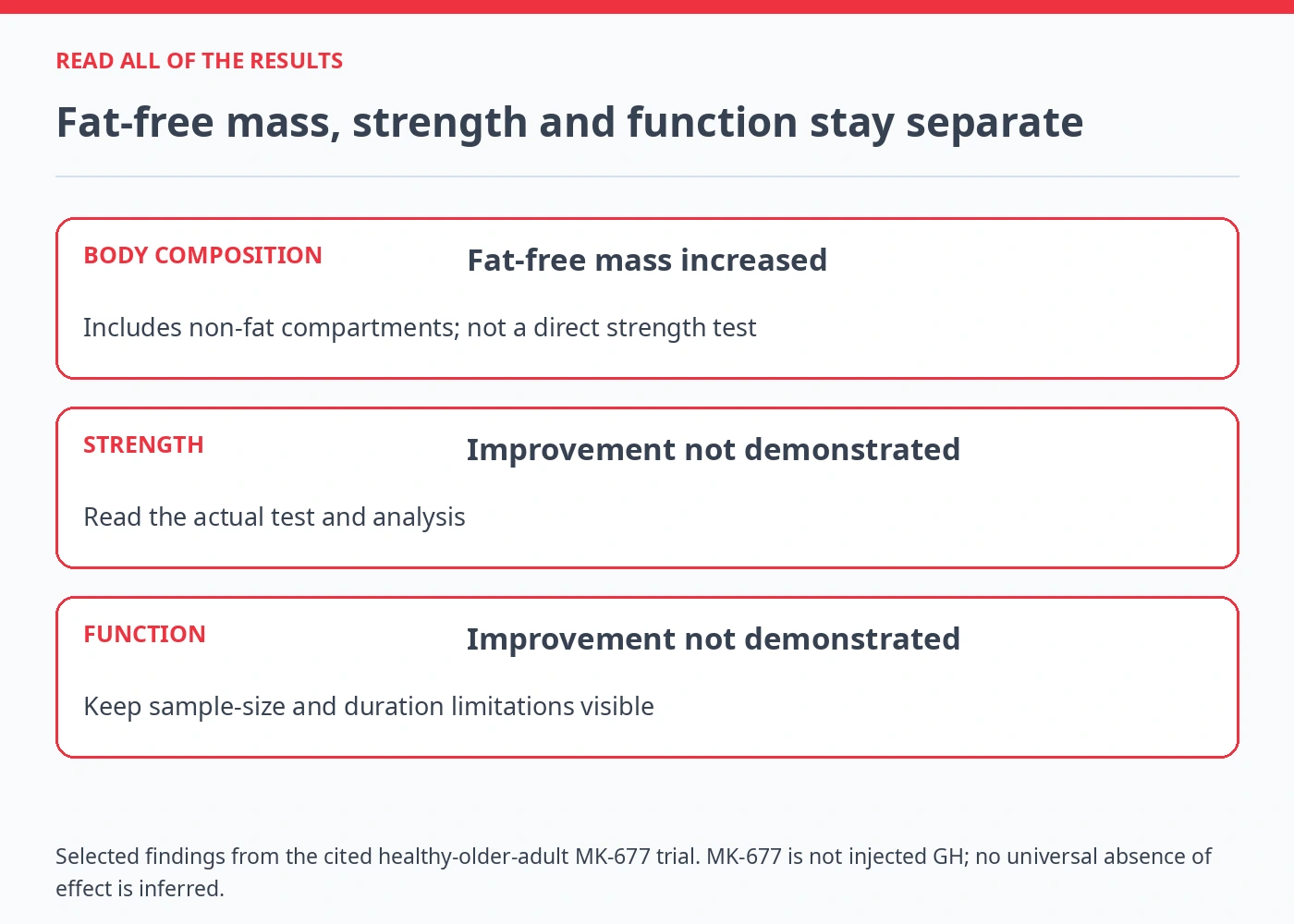
The MK-677 trial measured fat-free mass, including a DXA-based assessment. Fat-free mass is not a direct count of working muscle fibers, and body water contributes to the non-fat compartment. Keep the measurement method with the result instead of shortening it to “gained useful muscle.” The name of the quantity limits what can be inferred from it.
The Endocrine Society’s aging statement discusses body-composition and functional findings as distinct parts of intervention evidence. A favorable change in one does not automatically fill the others. If a summary uses the broad word “muscle,” return to the original outcome definition and ask whether strength or a practical task was also tested. [2] [1]
Read the strength and function findings on their own
In the cited healthy-older-adult trial, MK-677 increased fat-free mass, but an improvement in the measured strength or function outcomes was not demonstrated. MK-677 is a ghrelin mimetic, not injected GH. The result should retain both that intervention identity and the distinction between the measured outcomes.
The authors discuss limits on assessing functional endpoints, including study size and duration. “No improvement demonstrated in this trial” is therefore more accurate than “no effect is possible in any setting.” At the same time, those limitations do not justify claiming a benefit the trial did not show. Uncertainty is not a positive result waiting to be assumed. [2]
Three measurements, three separate result questions
This table is an original reading framework. The MK-677 row refers to the cited trial; it does not represent injected-GH evidence.
| Part of the claim | What to retain | What remains separate |
|---|---|---|
| Composition | Identify fat-free or lean-mass measure and method | Not a direct measure of strength |
| Strength | Identify the specific force test and analysis | A separate endpoint with its own uncertainty |
| Function | Identify the practical task or daily-life outcome | Not supplied by the composition result alone |
| MK-677 example | Fat-free mass increased; strength/function improvement not demonstrated | Retain both findings and trial limits |
| Broader claim | “Participants became more independent” | Needs evidence directly relevant to independence |
A composition result cannot stand in for independence
Suppose a summary reports the body-composition finding but omits the measured functional outcomes, then says participants became more independent. The final claim adds a practical result that the selected composition measure does not establish. Reporting the scan more precisely does not fix that change in endpoint.
A better account separates composition, strength and function. For each, state what was measured, what the comparison found and what remains uncertain. If a daily-life outcome was not assessed, label it unmeasured rather than treating it as an obvious consequence of the other result.
Use the endpoint that matches the real question
If the question is whether someone can climb stairs, carry shopping or manage a usual task more easily, look for evidence about an appropriate functional outcome. A research strength test may also answer a different question from independence in daily life. Keep the task and population identifiable rather than calling every favorable measure “better function.”
The reading framework does not set a body-composition target, meaningful-change threshold or treatment plan. It helps prevent an attractive result in one category from replacing missing evidence in another. Benefits, harms and practical burden still need to be considered in the actual clinical context.
For the wider marker-versus-benefit question, see A Biomarker Change Is Not the Same as a Health Benefit
For reviewing meaningful goals in prescribed care, read Reviewing Treatment Goals and Benefits With Your Clinician
The MK-677 example must not be relabelled as injected-GH evidence
The MK-677 example is not injected-GH evidence. No exercise, hormone or body-composition target is recommended.
Sources and reading context
- Endocrine Society scientific statement on hormones and aging — Distinguish biomarker, body composition and functional outcomes; no anti-aging recommendation
- MK-677 trial in healthy older adults — Ghrelin mimetic, not injected GH. Year1 randomized primary analysis; year2 exploratory. No demonstrated function benefit is not universal proof of absence