A Biomarker Change Is Not the Same as a Health Benefit
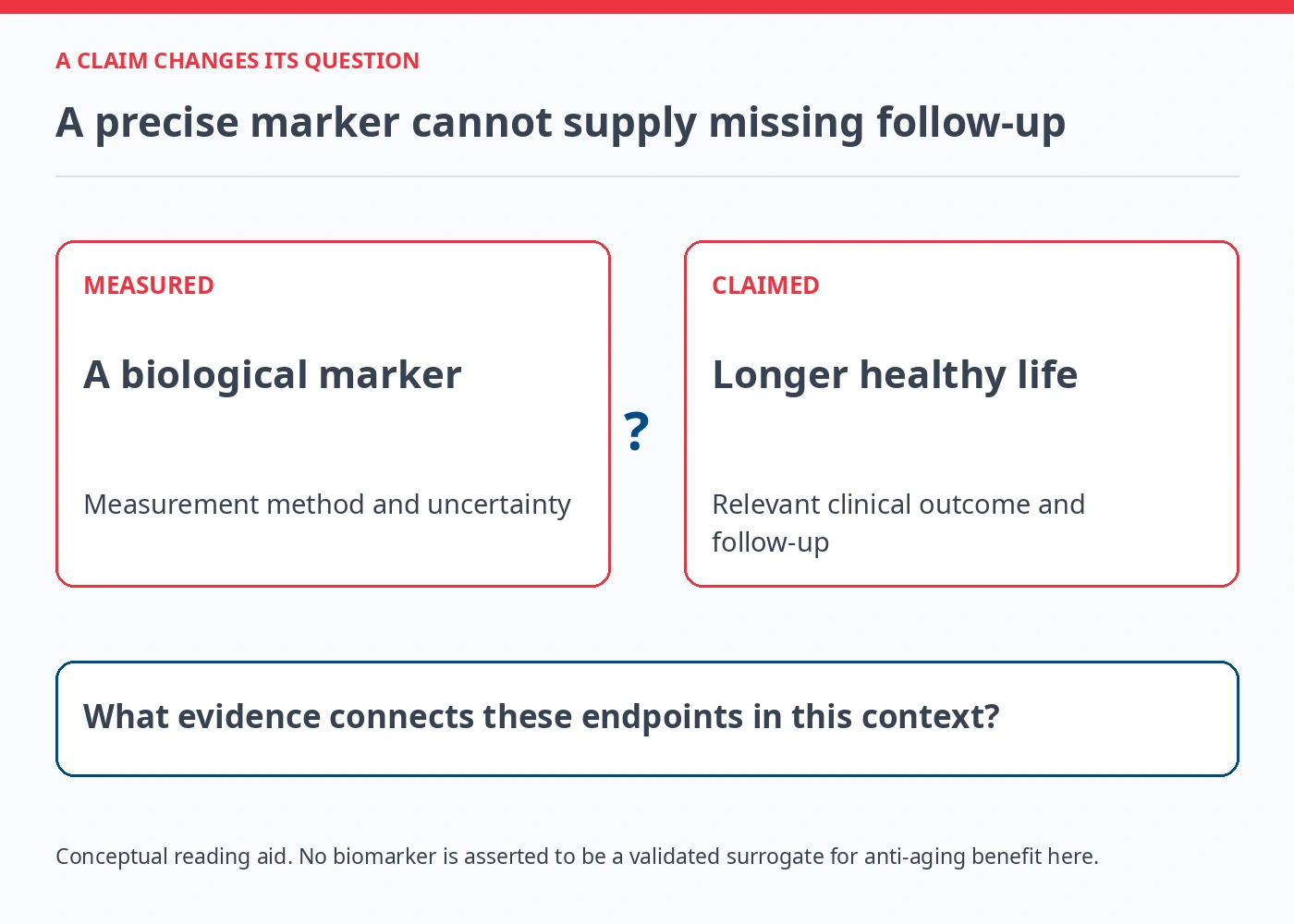
A laboratory marker can change without showing that a person feels better, functions better or lives longer. When a claim highlights “improved hormones,” first name the measured quantity and the promised benefit. The distance between those two statements is the evidence question the headline may have skipped.
Write down the measurement before judging the change
FDA distinguishes biomarkers from clinical outcomes and describes surrogate endpoints within defined contexts. A concentration in a blood sample and a person’s ability to carry out a daily task are different observations. “Improved” is therefore not a complete description of a marker: it leaves the direction, unit, population and intended meaning unclear.
A useful reading note identifies what was measured, when and in whom. Keep the comparator and uncertainty if the study provides them. Do not rename a larger or smaller value as better health until the evidence supports that interpretation. A technically precise assay can answer a measurement question well while leaving a practical benefit question open. [1]
For recording nutrition and illness context around an IGF-1 result, see Nutrition, Illness, and IGF-1: Context to Bring to an Appointment
Check whether the marker can stand in for this outcome
A surrogate endpoint needs evidence supporting its relationship to a clinical benefit in the relevant use. That relationship cannot be assumed for every disease, intervention or population. Even if a marker is useful in one clinical setting, the same measurement in another setting may not justify the same conclusion.
The Endocrine Society’s aging statement discusses the complexity of age-related hormonal changes and intervention evidence. It does not make an isolated IGF-1 change a general anti-aging outcome. Keep a study’s actual result separate from a claim that the change reverses aging or extends life. The larger promise requires evidence appropriate to that promise. [1] [2]
For a claim about memory or dementia prevention, check what a brain-health claim actually measured before treating a biological marker as that clinical outcome.
A marker result beside a fictional longevity claim
This original example explains how to examine a claim. Any fictional claim is labelled and is not a quotation, clinical result or recommendation.
| Question | What to identify | Why it matters |
|---|---|---|
| Observed result | A short study reports a change in a laboratory marker | Identify the exact marker, unit and comparison |
| Advertised promise | Fictional claim: “This means you will live longer” | Lifespan is a different outcome |
| Direct measurement | The short study did not observe longer survival | The promised outcome remains unmeasured |
| Surrogate question | Was a valid relationship established for this use? | Do not borrow validation from another setting |
| Appropriate summary | Describe the marker result and the unresolved benefit | More precision in the marker does not fill the gap |
A more precise marker does not become a different endpoint
In the fictional claim, the laboratory result is used to promise longer life. Repeating the assay more precisely could reduce uncertainty about the marker itself. It would not, by that step alone, supply observations of survival or establish that changing the marker causes longer life.
The careful summary can acknowledge the biological finding without accepting the extra promise. Ask whether the clinical outcome was measured directly or whether a justified surrogate relationship applies. If neither is established, keep the outcome gap visible rather than describing the entire study as either proof of benefit or useless.
For an example of keeping somatropin claims attached to the outcomes actually supported, see HGHThai’s benefits-and-limitations discussion
Use the distinction to ask a better question
Place the measured endpoint and the proposed use on separate lines. For each, identify the population and time horizon. This often reveals whether the claim changes the audience, intervention or outcome as it moves from the study to the advertisement. A missing connection should be recorded as missing, not supplied by a plausible mechanism alone.
Biomarkers can be valuable for research and clinical care. Their value does not depend on treating every marker as a substitute for every outcome. This guide provides no biomarker target or individual interpretation; it helps a reader ask exactly which conclusion the evidence supports.
Keep lifespan and healthspan claims distinct using Healthspan and Lifespan: Different Questions in Aging Research
No marker target or hormone treatment follows from this guide
No biomarker target or hormone treatment is recommended. This article does not evaluate an individual result or establish that changing a marker will improve health.
Sources and reading context
- FDA surrogate endpoint resources — Surrogate validation is context-specific; IGF-1 change is not a validated general anti-aging outcome
- Endocrine Society scientific statement on hormones and aging — Distinguish biomarker, body composition and functional outcomes; no anti-aging recommendation