Reading Brain-Health Claims About Hormones With Appropriate Caution
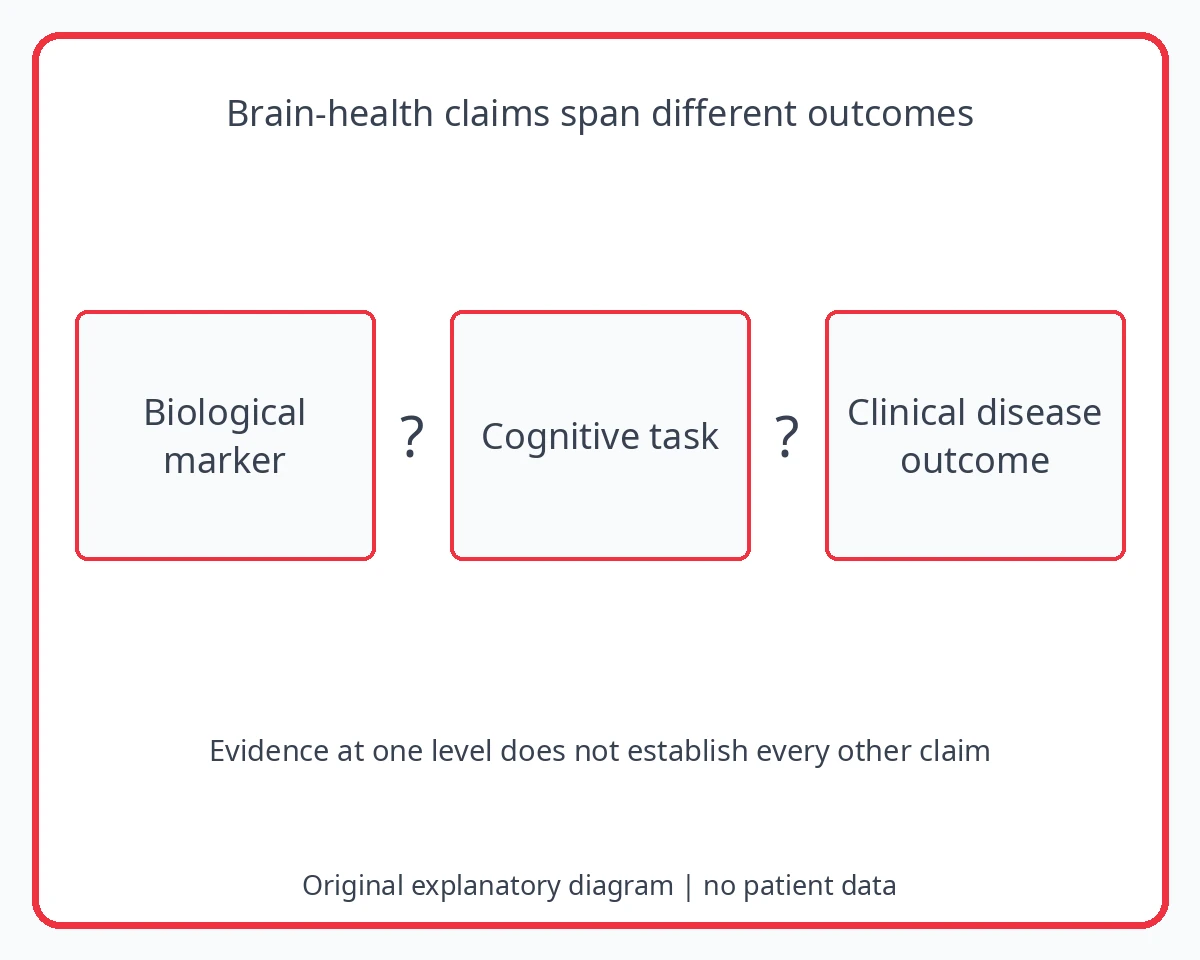
A claim about “brain health” may refer to a laboratory signal, a memory task or a long-term clinical outcome. Those are not interchangeable results. Before asking whether a study is positive, identify what it actually measured and whether that matches the benefit being promised.
Write the measured endpoint in ordinary language
FDA’s biomarker resources distinguish biological measurements from clinical benefit. A marker may be useful for a particular research question while its relationship to a different practical outcome remains unestablished. Naming a pathway or showing a biological response does not by itself demonstrate better memory in daily life.
A cognitive task also answers a narrower question than a long-term disease outcome. Keep the task, its scoring and the study period visible. Do not silently turn performance on one test into prevention of dementia, or treat an unmeasured daily-life benefit as an obvious consequence of a favorable laboratory result. [1]
Keep the experimental setting attached to the result
FDA’s dietary-supplement claim-substantiation guidance emphasizes whether the research is relevant to the actual claim. A cell experiment, an injured-animal model and a trial in healthy adults involve different populations and settings. Evidence from one may raise a question for another; it does not make the second study unnecessary.
The Endocrine Society’s aging statement provides broader hormone-research context without establishing a general brain-health benefit from GH. Retain the exact intervention, health status and follow-up. Sharing a biological pathway is not enough to treat two substances or two clinical populations as the same experiment. [2] [3]
Find the endpoint that the advertisement adds
This fictional reading exercise has no actual brain-test result or intervention effect.
| Reading question | What the example shows | What remains unresolved |
|---|---|---|
| Reported experiment | A biological marker changed | Was a patient-relevant outcome measured? |
| Advertisement | Claims better everyday memory | A marker alone does not establish this |
| Further promise | Suggests long-term disease prevention | Requires evidence about that different outcome |
| Setting | Cell, animal or human research | Do not omit species and health status |
| Time | The actual observation period | A short observation cannot directly show a long-term result |
A more precise marker does not answer a different question
Suppose a laboratory study measures its marker very precisely, but an advertisement describes the result as protection against future dementia. Improving the precision of the marker does not supply the missing clinical follow-up. The problem is a change in the question, not merely a small sample or an unclear graph.
A faithful summary says what changed, in which experimental setting, and what was not tested. If the study did include a relevant cognitive or clinical outcome, read that result separately rather than assuming it must agree with the biological measurement.
For translating animal findings cautiously, see From Animal Longevity Studies to Human Claims: The Missing Steps
Look for a direct test of the practical promise
For a real cognitive study, inspect the comparison, the assessment method, missing data and the authors’ discussion of repeated testing or other limitations. These are reading questions, not a validated score for judging a paper. The aim is to locate the evidence that can address the advertised outcome.
A broad phrase becomes useful only when its meaning is specific enough to evaluate. Keep an unanswered question open rather than filling it with an appealing mechanism. This guide neither assesses anyone’s cognition nor recommends a memory test, dementia treatment or hormone regimen.
For the limits imposed by follow-up duration, read Short and Long Follow-Up: Reading Growth-Treatment Studies
A mechanism is not a demonstrated brain-health benefit
No memory test, dementia diagnosis or hormone treatment is recommended. This guide does not establish a brain-health benefit for GH.
Sources and reading context
- FDA surrogate endpoint resources — Surrogate validation is context-specific; IGF-1 change is not a validated general anti-aging outcome
- FDA substantiation of supplement claims — Evidence and claims evaluation; US guidance not local legal permission
- Endocrine Society scientific statement on hormones and aging — Distinguish biomarker, body composition and functional outcomes; no anti-aging recommendation