From Animal Longevity Studies to Human Claims: The Missing Steps
A long-lived animal with altered GH signaling is not evidence that an adult should take GH. The species, direction of the alteration and time it began all matter. A lifelong genetic condition and an intervention started in adulthood are different experiments, even when a headline gives both the same hormone label.
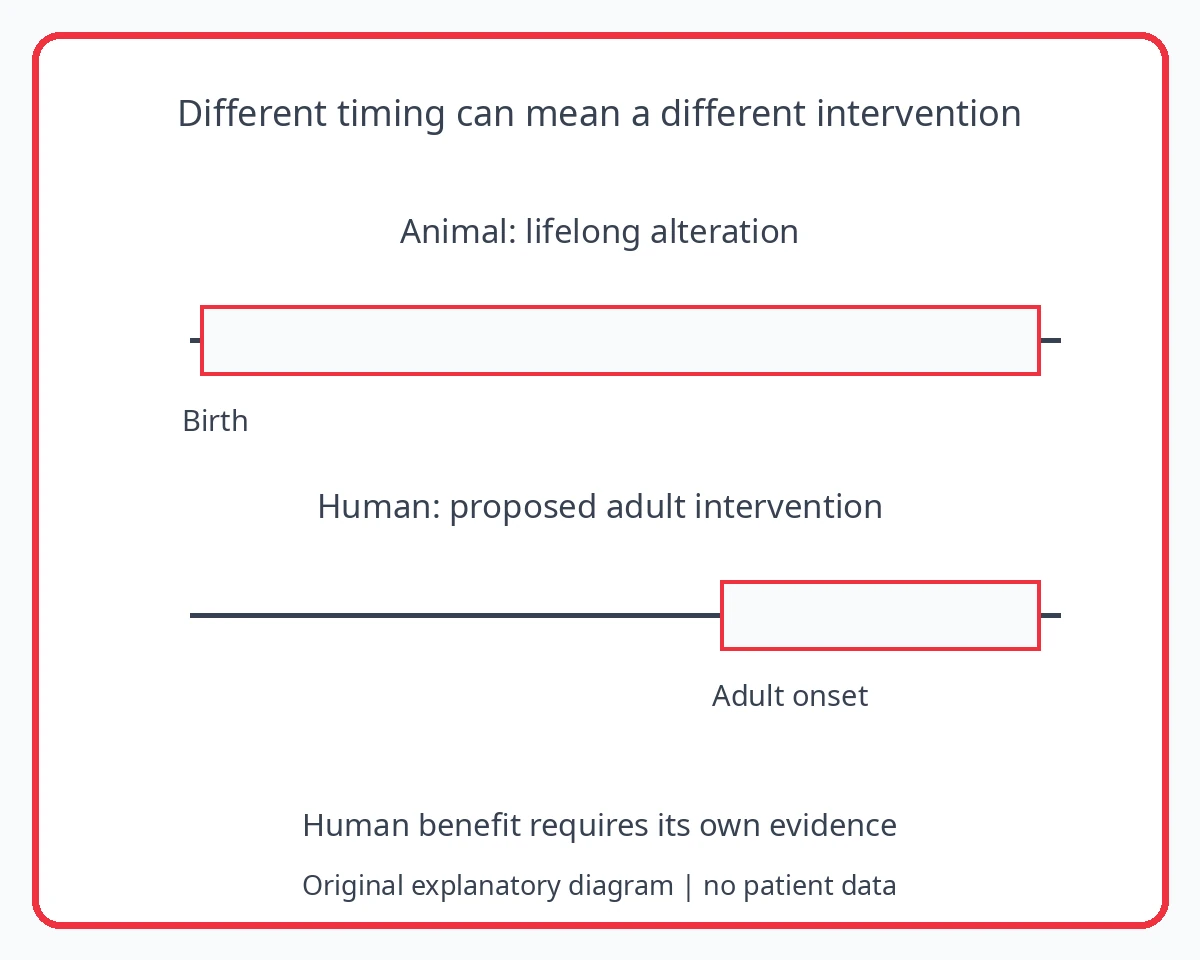
Identify what was changed and in which direction
The Endocrine Society statement discusses animal models in which changes reducing GH-related signaling are associated with longer lifespan, as well as contrasting models. It also emphasizes the lifelong nature of such experiments. Summarizing this only as “GH affects aging” removes the direction and timing needed to understand the finding.
Read the exact model and intervention before making a comparison. Was a receptor or release pathway altered throughout development, or was a substance administered later? Those differences can change the biological question. The conceptual table here does not represent one named experiment or calculate an effect size; it exposes the details a translation claim must retain. [1]
Compare the proposed human intervention on its own terms
A proposed adult intervention may change signaling in a different direction and after decades of development under ordinary conditions. A shared pathway name does not make it equivalent to the animal model. The mechanism can suggest a research question while leaving the effect in humans unanswered.
The statement distinguishes aging-related endocrine questions from established endocrine disorders. Evidence about treating diagnosed deficiency should not be silently combined with a claim about extending life in healthy adults. Keep the proposed human population visible, including whether it matches any human evidence cited alongside the animal work. [1]
A fictional jump from animal biology to adult treatment
This original example explains how to examine a claim. Any fictional claim is labelled and is not a quotation, clinical result or recommendation.
| Question | What to identify | Why it matters |
|---|---|---|
| Animal description | Lifelong genetic alteration of a GH-related pathway | Identify species, direction and developmental exposure |
| Human proposal | Begin a hormone-related intervention in adulthood | Timing and intervention may be different |
| Outcome in the claim | Longer human life | Requires evidence about that human outcome |
| Missing bridge | No matching human outcome study supplied in the example | Biological plausibility is not the missing trial |
| Reading task | Compare mechanism, population, benefit and harms | Do not transfer the animal result automatically |
The direction of the intervention can be lost in a headline
A fictional headline links reduced signaling in a long-lived animal to a proposal that adults should increase hormone exposure. Before asking how large the benefit might be, notice that the description has changed the direction of the intervention. It has also replaced lifelong biology with adult treatment.
Those changes do not prove that every human study would fail. They show why the animal finding cannot answer the proposed treatment question by itself. A suitable human study would need to examine the actual intervention, relevant outcomes and harms in the intended population.
For causal interpretation beyond the mechanism, see What an Observational Growth Study Can and Cannot Establish
Look for evidence that addresses the human claim directly
Ask what human study, if any, tests the proposed intervention and which outcome it observes. A laboratory marker over a short interval is not a direct observation of lifespan. Keep the comparator, follow-up and unwanted effects beside any benefit result. Do not treat the absence of a matching study as permission to invent a likely gain.
Animal research can be scientifically important without serving as a treatment recommendation. The useful conclusion names what the model reveals and what remains untested in people. This reading method supplies no anti-aging regimen or individual lifespan estimate and does not determine anyone’s prescribed care.
For evaluating the human study that would be needed, read Reading Anti-Aging Treatment Studies in Healthy Adults
Animal mechanisms do not supply a personal treatment decision
No animal finding is used here to recommend or reject treatment for an individual. The article supplies no anti-aging regimen or human lifespan estimate.
Sources and reading context
- Endocrine Society scientific statement on hormones and aging — Distinguish biomarker, body composition and functional outcomes; no anti-aging recommendation