Reading Anti-Aging Treatment Studies in Healthy Adults
Healthy older volunteers, frail adults and people with diagnosed GH deficiency are different study populations. A claim that merges them can overstate who the evidence applies to. Read the eligibility criteria and the exact intervention before deciding what a reported result says about aging.
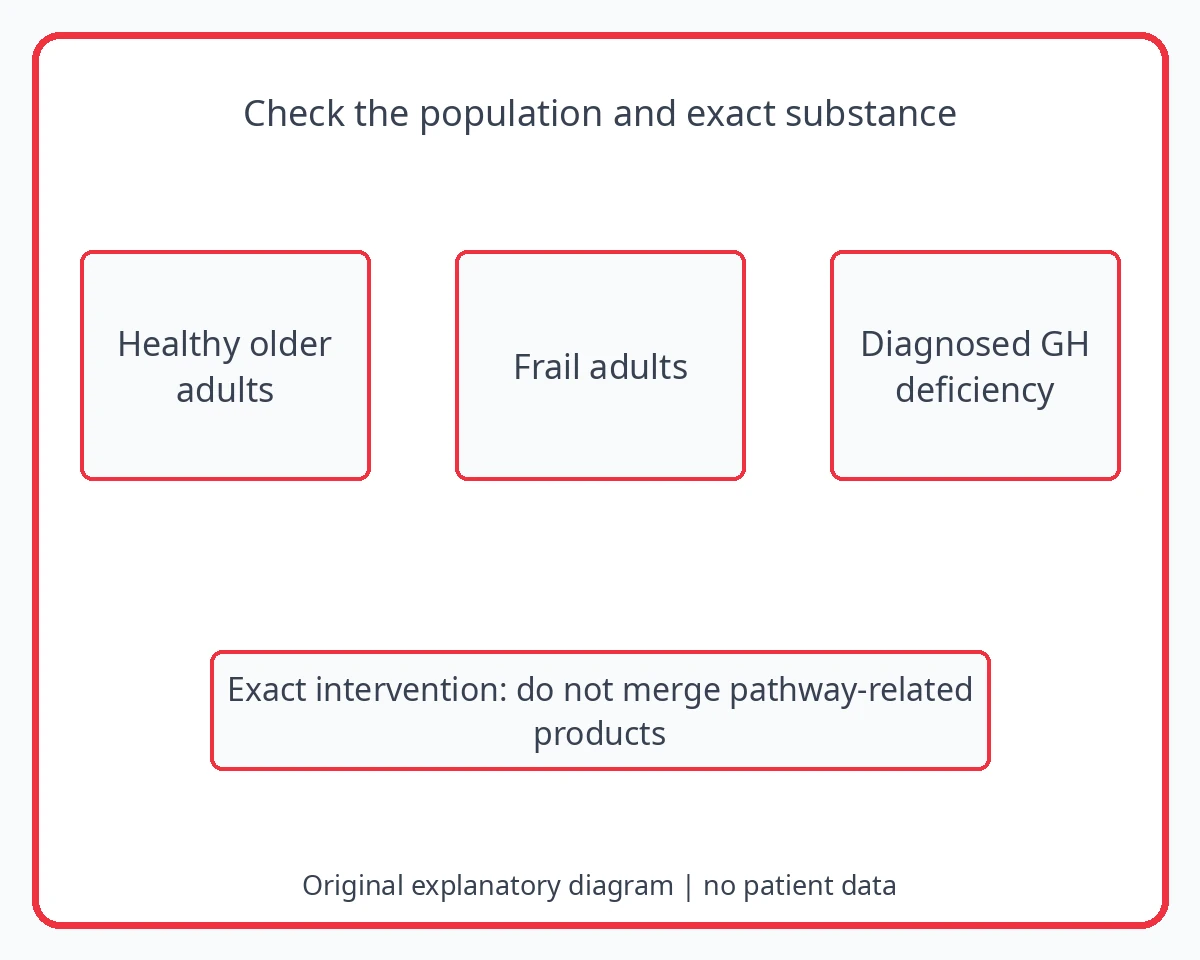
Start with who could enter the study
The Endocrine Society’s statement reviews age-related endocrine questions in context. For an individual study, inspect participants’ health status, age and entry criteria rather than relying on “older adults” alone. Exclusions are part of that description: people excluded for a relevant condition were not automatically represented by those enrolled.
The MK-677 trial studied healthy adults aged 60 and over and excluded diabetes, among other conditions. It was not a trial in every frail older person or in a population selected for diagnosed GH deficiency. These eligibility details matter when an advertisement targets people whose health circumstances differ from the volunteers. [1] [2]
For why diagnosed adult GH deficiency differs from normal aging, read HGHThai’s adult GHD explanation
Keep the substance distinct from the pathway it affects
MK-677 is an oral ghrelin mimetic, not injected GH replacement. A trial of one cannot simply be relabelled as a trial of the other because both concern the GH–IGF-1 pathway. The exact substance, formulation and experimental conditions belong to the evidence description; this article does not provide a regimen for readers.
When comparing a study with a claim, write the intervention name on both sides. Then check whether the claim also changes the population or outcome. Several small wording changes can together produce a statement the paper never tested, even though every sentence still contains familiar hormone terminology. [2]
If the headline also calls the medicine approved, separate approved indications from an advertised purpose; product approval does not establish that the broader aging claim was studied.
A study description and a broader fictional headline
This original example explains how to examine a claim. Any fictional claim is labelled and is not a quotation, clinical result or recommendation.
| Question | What to identify | Why it matters |
|---|---|---|
| Studied population | Healthy older adults in the MK-677 trial | Eligibility and exclusions define the audience |
| Intervention identity | Oral ghrelin mimetic MK-677 | Not injected GH replacement |
| Fictional headline | “GH therapy works for aging” | Changes the intervention and broadens the question |
| Outcome check | Read the actual measured endpoint and duration | Do not replace it with general rejuvenation |
| Applicability question | Does the evidence match the proposed person and use? | Similarity of age alone is insufficient |
Restore the population, substance and outcome before judging the claim
The fictional headline converts a specific trial into a general statement about GH therapy and aging. Restoring “MK-677 in healthy older volunteers” corrects two parts of the description, but the outcome still needs to be named. A body-composition result is not automatically a result about independence or lifespan.
If the claim concerns a frail person with diabetes, the reader should notice that the proposed audience differs from the trial’s eligibility. That difference does not provide a personal safety verdict. It identifies where extrapolation begins and why a clinician cannot treat the headline as an individualized recommendation.
Check the endpoint, comparator and follow-up together
Cochrane’s interpretation guidance emphasizes applicability and uncertainty. Look for the functional or clinical outcomes actually measured, the alternative condition and the period observed. A limited follow-up can provide useful evidence about its endpoints while leaving longer-term questions unresolved. Do not assign the longest imaginable benefit to the shortest measured change.
Keep harms and practical burden visible alongside favorable findings. A study-reading note should explain what the result supports and what the proposed use adds beyond it. This guide does not establish treatment suitability, prescribing permission or anti-aging efficacy for an individual; it helps prevent a population or product switch from disappearing into a broad claim. [3]
When the outcome is lean mass, also read Lean Mass and Muscle Strength: Why Studies Measure Both
Check the study phases and follow-up using Short and Long Follow-Up: Reading Growth-Treatment Studies
Applicability needs more than a shared age category
No treatment suitability, prescribing permission or anti-aging efficacy is established for healthy people. This article is a study-reading method.
Sources and reading context
- Endocrine Society scientific statement on hormones and aging — Distinguish biomarker, body composition and functional outcomes; no anti-aging recommendation
- MK-677 trial in healthy older adults — Ghrelin mimetic, not injected GH. Year1 randomized primary analysis; year2 exploratory. No demonstrated function benefit is not universal proof of absence
- Cochrane Handbook chapter 15: interpreting results — Interpretation and applicability; precision does not remove bias