Approved Indications and Off-Label Claims: Reading the Difference
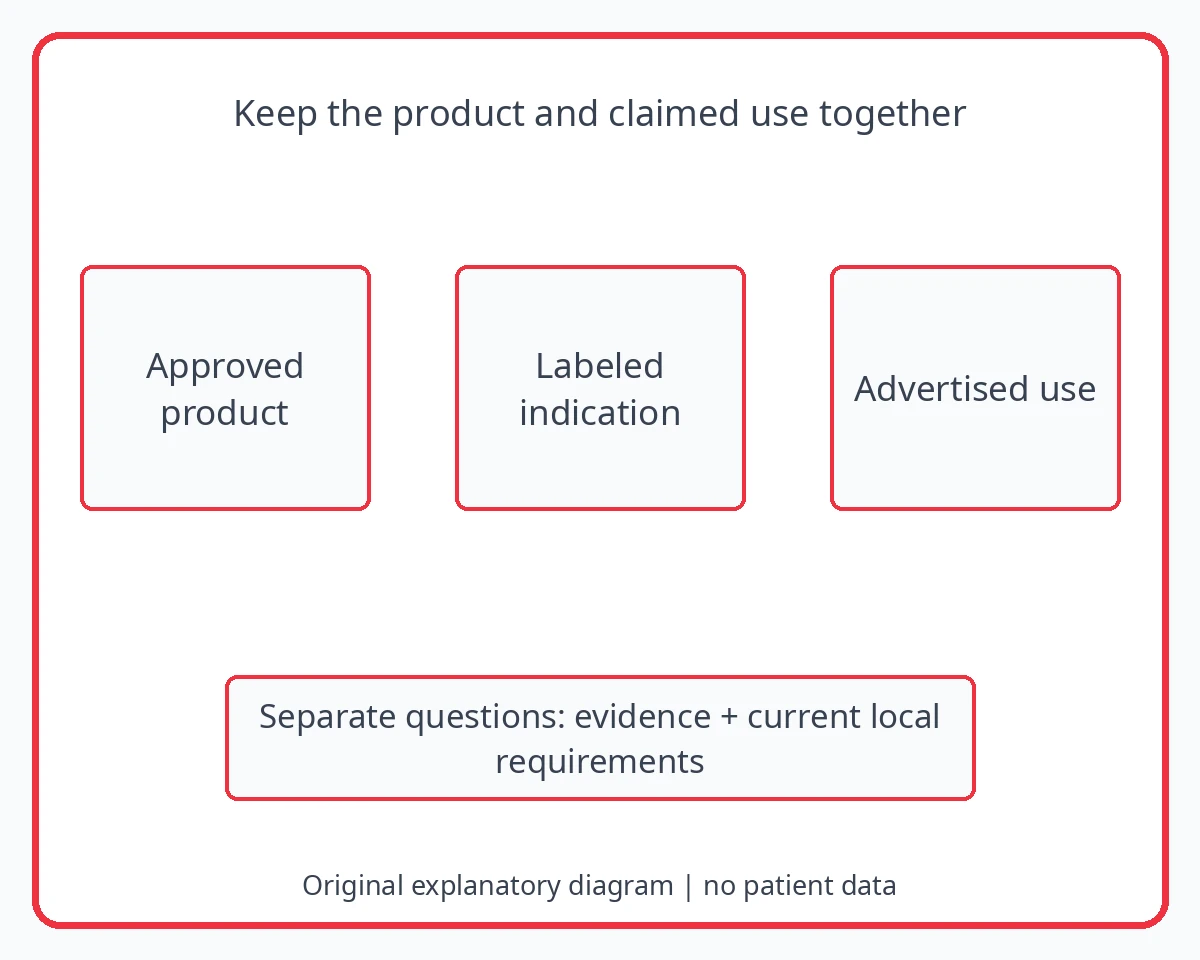
An advertisement can name a real medicine and still make a claim outside its approved use. For a Swedish reader, start with the exact Swedish product information. The medicine’s identity, its stated indication and the advertised purpose are three separate things to compare.
Find the indication in the matching Swedish product document
The Genotropin summary of product characteristics displayed by FASS provides a concrete example. Its adult indication concerns replacement treatment in pronounced growth hormone deficiency. That is a defined clinical context, not a general statement that an adult who wants to look or feel younger should receive the product. The document also contains assessment requirements and other conditions that a short advertisement may omit.
Use the exact product, strength and presentation to identify the relevant information. The cited document covers Genotropin powder and solvent presentations and records an August 2024 revision. FASS supplies product information; it is not the Swedish medicines regulator. Check the current matching document when reviewing a real proposal, and retain its date rather than assuming all brands or countries have identical wording. [1]
For differences between product documents across markets, see Why Growth Hormone Product Leaflets Can Differ Between Countries
For clearly labelled examples of product-specific US indications, see HGHThai’s somatropin indication overview
Understand what the term off-label does and does not answer
EMA’s glossary uses off-label terminology for use outside approved particulars, such as the indication, age group, dose or route. This describes a relationship to the authorization. It does not itself demonstrate benefit for a new purpose, identify a suitable patient or decide the requirements for a particular Swedish clinical situation.
Suppose an advertisement says “approved medicine” and then promises rejuvenation. The first statement does not make the second an approved indication. Likewise, calling the proposal “off-label” does not resolve the evidence gap. Ask the clinician to identify the exact proposed purpose, its evidence and the applicable local requirements as separate questions. [2]
Follow the claim from product to purpose
This fictional advertisement is not a quotation from a real provider. The Swedish product-information example is identified separately.
| Reading question | What the example shows | What remains unresolved |
|---|---|---|
| Product document | Genotropin information on FASS | Match the actual presentation and current document |
| Adult indication example | Replacement in pronounced GH deficiency | Full criteria require the original document and assessment |
| Fictional advertisement | Approved medicine, followed by a rejuvenation promise | Approval for the advertised purpose is not established |
| Evidence question | What directly tests that promise? | The medicine name does not supply the answer |
| Local practice question | Which current requirements apply? | The word off-label is not individual authorization |
One true statement can be followed by an unsupported inference
Imagine that the advertisement links to a genuine product document. That improves traceability, but the reader still has to compare its indication with the claim being sold. A correct link cannot make the linked document say that general age-related changes are the same as diagnosed deficiency.
A useful written question is: “Which part of this product information covers the proposed purpose, and which evidence addresses that purpose if it is outside the indication?” It separates the two issues without asking the reader to diagnose deficiency or make a legal determination.
Read benefit and risk evidence for the proposed use
The Endocrine Society’s aging statement distinguishes treatment of established deficiency from attempts to alter ordinary aging. Its review does not turn a hormone level that changes with age into an individual treatment indication. A clinical proposal needs the patient’s actual assessment and evidence relevant to the intended outcome.
Keep the answer to each question distinct: product identity, labeled use, proposed purpose, evidence and local requirements. This guide helps prepare that discussion; it does not authorize prescribing, purchase or use, and it does not decide whether a particular proposal is lawful or appropriate. [3]
Assess the evidence for the proposed population separately using Reading Anti-Aging Treatment Studies in Healthy Adults
A terminology check is not permission to prescribe or use
This article is not legal advice or authorization to prescribe, obtain or use HGH. Confirm current product-specific and jurisdiction-specific requirements with qualified sources.
Sources and reading context
- FASS: Genotropin summary of product characteristics — Swedish Genotropin product information: adult replacement in pronounced GH deficiency; document revision 2024-08-20, not an anti-aging indication or legal determination. FASS is a product-information publisher, not the medicines regulator.
- EMA glossary: off-label use — Terminology for use outside approved particulars; not individual authorization or an efficacy claim.
- Endocrine Society scientific statement on hormones and aging — Distinguish biomarker, body composition and functional outcomes; no anti-aging recommendation