Testimonials and Treatment Evidence: How to Tell Them Apart
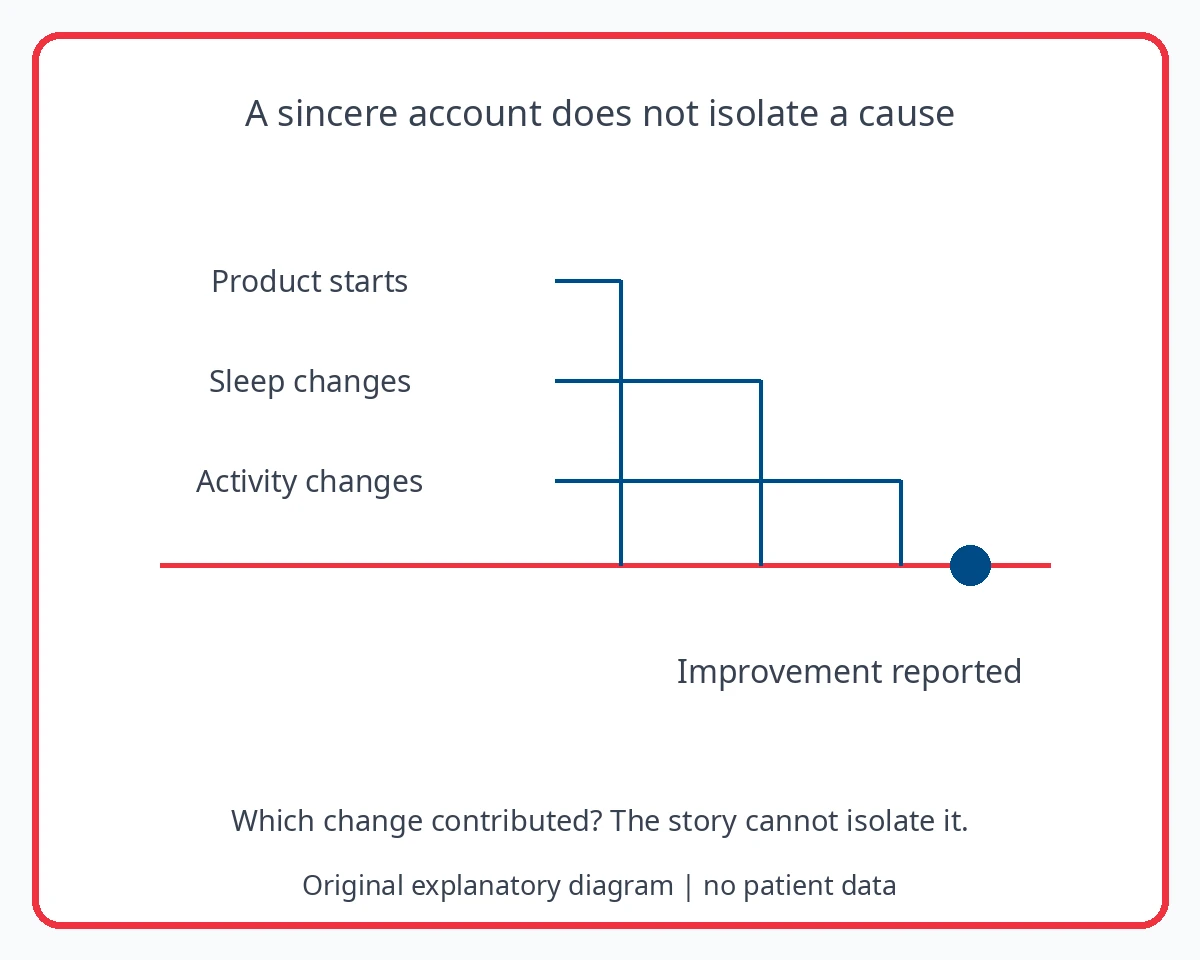
A person can sincerely feel better after starting a product while the story still leaves its cause uncertain. If sleep, activity and other care changed at the same time, the account cannot isolate how much each contributed. Respecting the experience and asking for causal evidence are compatible steps.
Keep the experience separate from the explanation
FDA’s dietary-supplement claim-substantiation guidance and Cochrane’s non-randomized-study methods give reasons to inspect the evidence behind a causal claim. A sequence of “started product, then felt better” is an observation about time. It does not by itself compare what would have happened under an alternative condition.
The point is not to decide whether the person is honest. Preserve what they actually report, the period involved and how they describe the change. Then identify which part of the advertisement goes further, such as claiming that the product caused the entire improvement or that another person can expect the same result. [1] [2]
For a formal explanation of alternative causal pathways, see What an Observational Growth Study Can and Cannot Establish
Ask which simultaneous changes the story includes
A new sleep routine, exercise schedule, medicine or change in circumstances can accompany the product. Their presence does not prove they caused the improvement either. They are competing context that the account may not be able to separate. Keep uncertainty visible instead of replacing one confident explanation with another.
Selection matters as well. A page of success stories does not show how many people tried the product, who did not improve or who stopped. More positive accounts do not automatically supply that missing denominator. A reader needs information about how the experiences were collected and selected before treating them as representative.
When the testimonial relies on skin photographs, also assess the conditions behind skin before-and-after images; the appearance and the explanation require separate checks.
Several changes before one improvement report
This fictional timeline is not a real testimonial or an allegation about a named person or product.
| Part of the claim | What to retain | What remains separate |
|---|---|---|
| Product | A new product was started | One event in the sequence |
| Sleep | A new sleep routine began in the same period | Another possible influence |
| Activity | Exercise scheduling also changed | The product is not the only change |
| Reported experience | Person says they feel better afterwards | The account may be sincere; contribution is unresolved |
| Missing comparison | No appropriate alternative condition observed | No individual treatment-effect estimate is available |
A longer list of stories does not create the missing comparison
In the fictional account, three changes begin near one another and improvement is reported later. The story cannot allocate a percentage of improvement to each change. Adding another similar success story does not solve that attribution problem; it adds another account with its own context.
A useful summary preserves the reported improvement and states what the account cannot isolate. It then looks separately for research on the actual product, population and outcome. That approach neither dismisses experience nor asks it to answer a question its design cannot settle.
Look for a direct test of the advertised claim
Ask whether comparative evidence measures the benefit the advertisement promises and addresses relevant alternative explanations. A citation about a different ingredient or an indirect marker may leave the testimonial’s practical claim unanswered. The presence of research and a personal story on the same page does not automatically connect them.
Keep unwanted effects and withdrawals visible when evidence is available. A claim about expected benefit should account for more than selected favorable experiences. This guide does not determine an individual response or accuse anyone of fabrication; it distinguishes an account of experience from evidence about causation and typical results. [1]
For questions about the size of claimed benefits, read Questions That Clarify Risk and Benefit in Longevity Marketing
An experience is not an individualized effect estimate
This article does not accuse any person of dishonesty or determine an individual treatment response. It provides no expected benefit based on testimonials.
Sources and reading context
- FDA substantiation of supplement claims — Evidence and claims evaluation; US guidance not local legal permission
- Cochrane Handbook chapter 24: non-randomized studies — Confounding and non-randomized study interpretation