Questions That Clarify Risk and Benefit in Longevity Marketing
“Risk doubled” can sound very different from “one more person affected per hundred,” even when both describe the same change. To interpret either phrase, you need the starting rate, the event, the comparison and the time period. A relative percentage alone leaves too much of the story out.
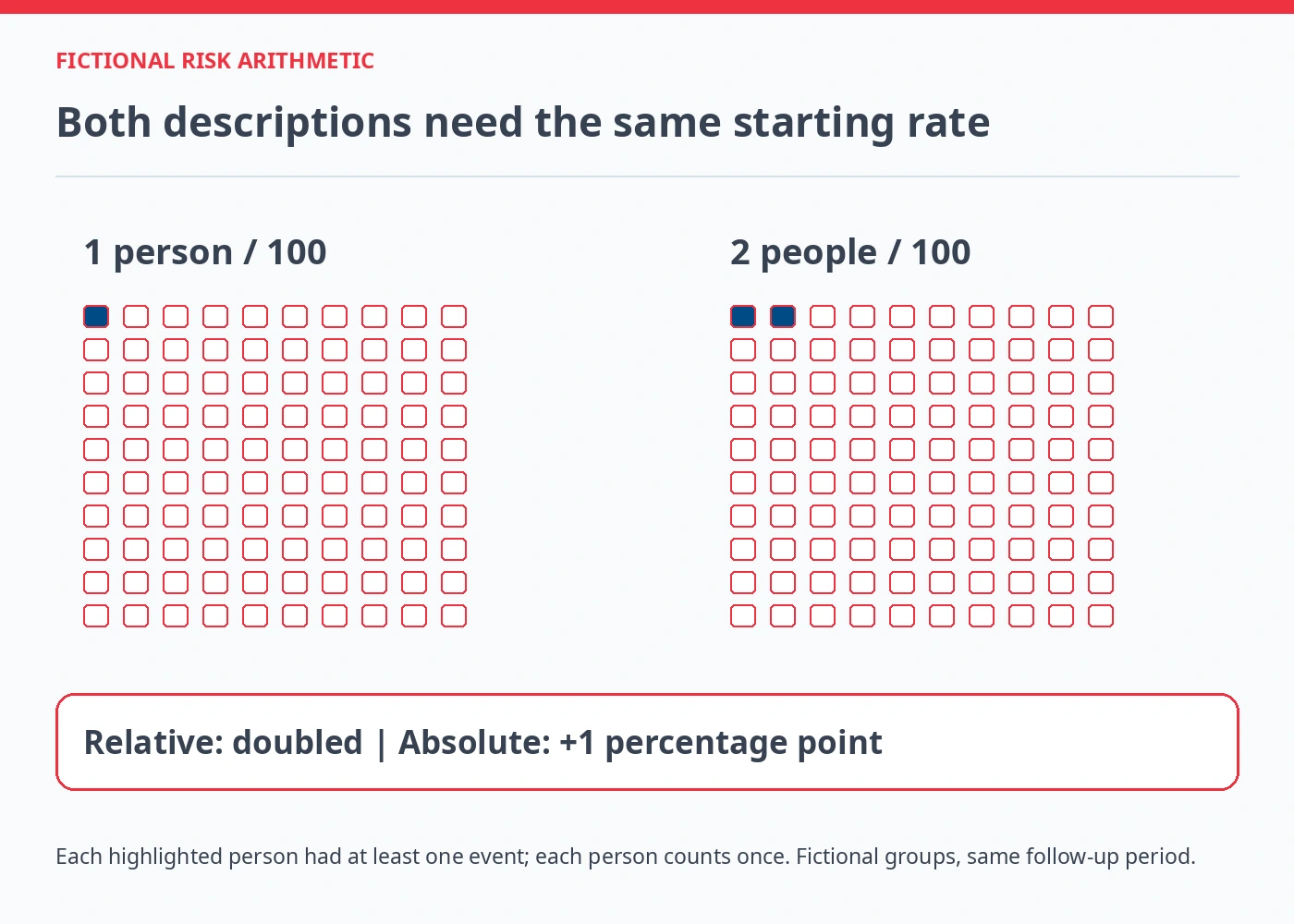
Translate the relative change into the same absolute scale
Consider a fictional comparison in which one of 100 people experiences at least one event, versus two of 100 over the same period. The proportion affected rises from 1% to 2%, a doubling in relative terms. The absolute increase is one more person affected per 100, or one percentage point. These are different descriptions of the same arithmetic, not competing results.
Cochrane’s effect-measure guidance explains why the measure and its comparison need to remain identifiable. A percentage without its denominator can conceal the starting rate. The invented numbers here are not a GH risk estimate and provide no individual prediction; they make the calculation visible so that a real claim can be checked on its own evidence. [1]
For other absolute-versus-relative changes, see Absolute and Relative Changes in Growth Research
Do not subtract outcomes measured in different ways
A benefit observed over several years and a harm recorded over a few weeks have different observation periods. A change in a questionnaire score and the probability of an adverse event also have different units. Neither pair can be reduced to a simple numerical “net benefit” by subtracting the printed numbers.
Cochrane’s interpretation guidance keeps outcome relevance, uncertainty and applicability in view. The Endocrine Society’s aging statement illustrates why a favorable hormone-related measurement needs to be read alongside harms and the actual population. A laboratory change does not automatically outweigh a patient-relevant unwanted effect. [2] [3]
Two descriptions of one fictional change
The two comparison groups use the same invented binary outcome—whether a person experienced at least one event—and the same follow-up period. No treatment or actual risk is assigned.
| Reading question | What the example shows | What remains unresolved |
|---|---|---|
| Starting rate | 1 of 100 people experienced at least one event | Outcome and duration must be supplied in real evidence |
| Compared rate | 2 of 100 people experienced at least one event | The comparison design still matters |
| Relative change | 2 divided by 1 = 2: a doubling | Does not show the baseline when stated alone |
| Absolute change | 2 minus 1 = 1 more person affected per 100 | One percentage point, not one percent relative |
| Benefit comparison | A different score or duration may be reported | Do not subtract unlike units or periods |
Neither wording is complete on its own
A headline uses “doubled,” while a response uses “only one more person affected per hundred.” In this invented example the arithmetic agrees. The disagreement in tone does not tell the reader how serious the event is, how long people were followed or how uncertain the estimate remains.
A clearer summary supplies both the absolute and relative comparison, then names the event and period. It leaves room for the reader to understand the consequence without choosing a dramatic or reassuring adjective as a substitute for the missing context.
When the claimed outcome is longer healthy life, clarify Healthspan and Lifespan: Different Questions in Aging Research
Make missing information part of the result
When reading an actual claim, keep the population, comparator, follow-up and interval estimates with the absolute results. If the starting rate is absent, record that gap instead of inventing it. If follow-up differs, preserve the difference rather than making the numbers look directly interchangeable.
The same discipline applies to benefit claims. Ask whether the endpoint is meaningful for the intended person and whether the evidence can answer the proposed question. This worksheet explains presentation and arithmetic; it does not calculate an individual benefit, balance personal preferences or recommend a hormone treatment.
The numbers illustrate arithmetic, not a treatment decision
No actual treatment risk, personal benefit estimate or recommendation is calculated here. The arithmetic cannot substitute for a clinical decision.
Sources and reading context
- Cochrane Handbook chapter 6: effect measures — Effect measurement and comparable outcomes; original arithmetic examples, no treatment estimates invented
- Cochrane Handbook chapter 15: interpreting results — Interpretation and applicability; precision does not remove bias
- Endocrine Society scientific statement on hormones and aging — Distinguish biomarker, body composition and functional outcomes; no anti-aging recommendation